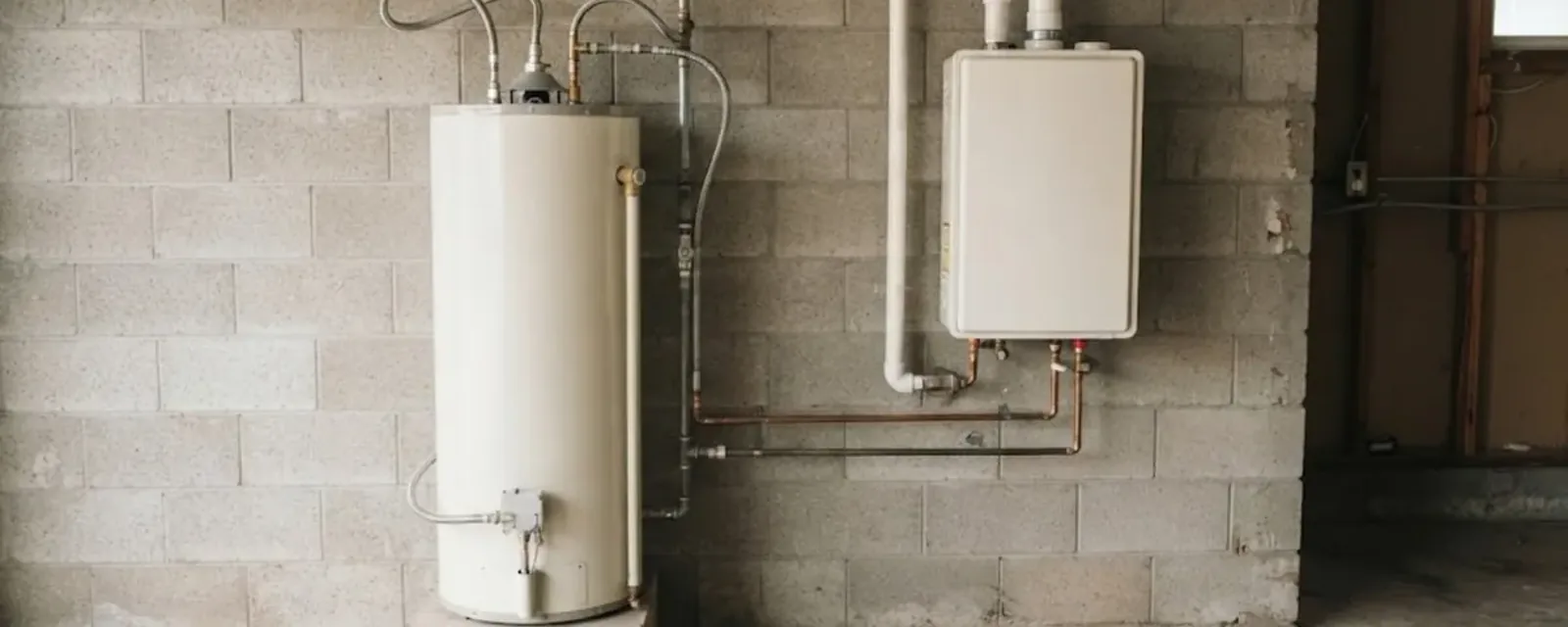
Water heater installation in Lawrence, MA is a project with a few real decisions: fuel, size, venting and where the unit will sit. Making them in advance beats making them on a cold night with a tank leaking. A plumber sets the heater, connects water and fuel, installs the code-required safety parts and arranges the permit.
This page covers planned installs, new builds and fuel changes. If your tank is already leaking, our water heater replacement page is the faster route.
Signs it is time to schedule an installation
You do not need a puddle to justify a new heater. These signals often show up first.
- The tank is old and the label shows a manufacture date well over a decade back.
- Hot water runs out sooner than it used to, even with the thermostat turned up.
- Rust-colored water appears only when you run hot taps.
- A rumbling or popping sound comes from the tank as it heats.
- Moisture or rust stains show around the base, the drain valve or the relief valve pipe.
- A remodel, an added bathroom or a new tenant means the existing tank is now too small.
- You want to move from oil or old electric to a more efficient system before winter.
Any one of these is worth a call. A stack of them means the tank is near the end of its useful life.
Fuel types and what each one asks of your house
The fuel decides the connections, the permit work and the long-term operating picture.
| Fuel | What it needs | Worth knowing |
|---|---|---|
| Natural gas | Gas line, vent to outdoors, combustion air | Gas fitting by a licensed gas fitter, CO detector required |
| Electric tank | Dedicated circuit and breaker | Simple connections, higher running cost than heat pump |
| Heat pump (hybrid) | Space around unit, condensate drain, outlet or circuit | Mass Save lists rebates for qualifying units in 2026, check the live page |
| Propane or oil-fired | Tank or line, vent, certified technician for oil | Oil burner work needs a state-certified oil burner technician |
| Indirect (boiler-fed) | Tied into the heating boiler | Hot water depends on boiler health, and Mass Save says fossil-fuel indirect rebates are gone |
Ask for two quotes if you are switching fuel. A like-for-like swap rarely needs more than one.
Venting, combustion air and carbon monoxide safety steps
A gas or oil heater exhausts through a flue, and a flue that is too short, too cold or crimped can spill exhaust into the room. Old chimneys that once served a boiler are often oversized for a modern water heater, and a liner may be needed. Your plumber should inspect the whole path from the heater to the roof cap.
Massachusetts requires a carbon monoxide detector on the same floor as a replaced vented gas appliance and on each habitable level. Combustion air matters as well, since a heater in a sealed closet can starve. Direct-vent and power-vent models solve most of these problems but need an outlet for the fan.
Ask whether the old vent can be reused as is. A plumber who says yes should be able to explain why, and a draft test with the heater running is a reasonable thing to request.
How a site visit sets up the installation
Before anyone quotes, the plumber looks at what is already there.
Read the existing setup
Fuel, tank size, flue path, water pressure and the drain location tell us what the new unit has to connect to.
Measure the space
Clearances for service, flue and a safe waste pan decide which models fit. A tape measure saves a return trip.
Check the supply
A gauge on a hose bib shows pressure. A meter or backflow device may make the system closed, which calls for an expansion tank.
Plan the permit
The plumber lists the work, files for the permit and arranges the inspection once the unit is set.
Planning an installation?
Call and tell us the fuel, the size of the home and whether this is a swap or a new location. We will book a visit and explain the options before any work.
Permits: ask the local plumbing inspector
Plumbing and gas fitting work that is installed, replaced or repaired needs a permit from the local inspector. In Lawrence, that is Inspectional Services at 200 Common St, Room 209, reachable at 978-620-3130. There is also an online permit portal.
The inspector typically responds to an inspection request within two working days, so ask your plumber to book it as soon as the work is nearly finished. For any question about your particular project, ask the local plumbing inspector. We do not guess at permit rules.
Tank, heat pump or on-demand
Each style fits a different kind of household.
Standard storage tank
- Lowest upfront cost and simplest install
- Fits most existing connections
- Keeps a reserve hot, so it loses some heat
- Good for steady, predictable use
Heat pump or tankless
- Heat pump uses less electricity but needs space and a drain
- Tankless needs a bigger gas line and its own venting
- Both can lower running cost for some homes
- Higher upfront cost and more planning
Our page on tankless water heaters covers gas line and venting needs in more detail.
New construction, additions and renovations
A new bathroom, a finished basement or a rebuilt kitchen can change hot water demand. The best time to rethink the heater is during the rough-in, while walls are open and gas, water and vent lines are easy to run.
For larger projects that touch more than the heater, see our page on plumbing installation. Plumbers coordinating with an electrician for a circuit or an HVAC contractor for a vent will usually save time if they are brought in early.
Installing in Lawrence basements and multi-unit buildings
About 28 percent of Lawrence housing units are in buildings of three or four units, and many sit in older brick buildings and mill-era blocks. Shared basements often hold several meters, boilers and pipes, so access and clearance can be tighter than they look. Ask for a site visit before choosing a model.
Lawrence draws its water from the Merrimack River, but the annual water quality report does not list hardness. Test your tap if scale is a concern, since a heater in hard water commonly needs flushing more often and may need a sediment plan from day one.
Source type: Lawrence Consumer Confidence Report
What shapes the price of an installation
You get a clear price before work starts. These factors drive it.
Water heater installation questions
A planned install can often be booked same day or within a few days, depending on the schedule. If the old tank is still working, you have time to compare fuels and quotes.
Plumbing and gas fitting work that is installed or replaced needs a permit from the local inspector. Ask the local plumbing inspector at Inspectional Services, 978-620-3130, about your specific project.
Yes, in many homes. It usually means a new circuit, capping the gas line and venting changes. Mass Save lists rebates for qualifying heat pump water heaters installed by a licensed plumber in 2026, so check masssave.com.
Often. An old chimney can be oversized for a modern heater, and a liner or a new vent may be needed. Your plumber should inspect the whole flue path.
Massachusetts requires one on the same floor as a replaced vented gas appliance and on each habitable level. Ask your plumber to confirm yours work.
Yes. Bring us in during rough-in so supply, drain, vent and fuel lines run cleanly. That is cheaper than cutting open finished walls later.
Massachusetts plumbing work in a home must be done by a licensed plumber with a permit. Gas work is licensed gas fitting. Only minor leak repairs and clearing a clog are permit-free.