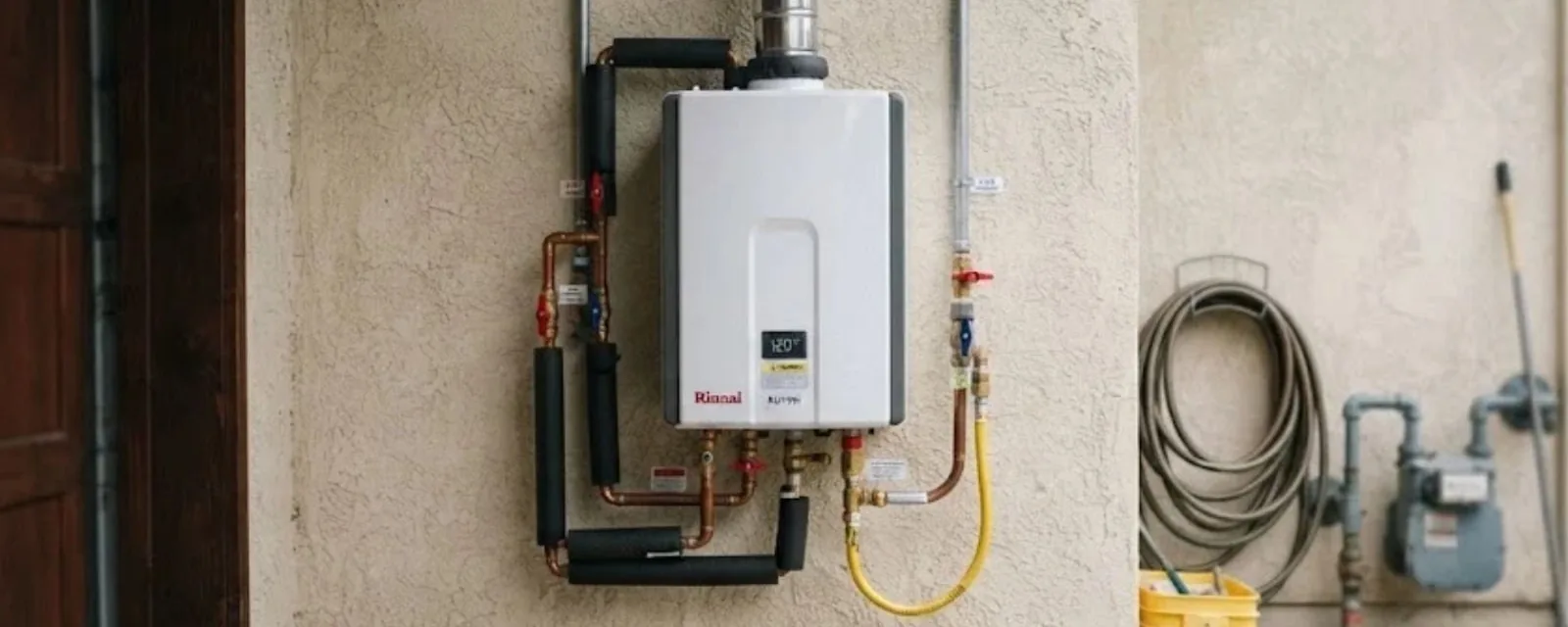
A tankless water heater in Lawrence, MA heats water as it flows instead of storing it, so the supply does not run out until demand outruns the burner. It sits on a wall, draws gas or electricity only while a tap is open, and takes far less floor space than a 40 or 50 gallon tank.
The catch is that a tankless unit asks more of your gas line, venting and water than a tank does. This page explains how to decide, how to maintain one and when to call.
Running out of hot water halfway through a shower?
A shower that goes cold after ten minutes or a house where the dishwasher steals heat from the bath is a classic sign of an undersized or tired storage tank. The technical answer is a tankless water heater, which heats on demand instead of draining a fixed supply.
Not every cold shower needs a tankless unit. A failed element, a bad dip tube or sediment can cause the same symptom in a standard tank, and a repair may be cheaper. A plumber should rule those out before selling a new system, and our page on water heater repair covers the usual faults.
Flushing and descaling a tankless heater
Tankless units have narrow heat exchanger passages, and minerals in the water can coat them with scale. Scale makes the unit work harder, trigger error codes, shorten bursts of heat and reduce efficiency. Flushing with a mild descaling solution, circulated through the unit by a pump, dissolves that buildup.
How often depends on your water. The annual water quality report from Lawrence Water & Sewer does not list hardness, so test your tap before choosing an interval. Harder water often calls for yearly flushing, and softer water may allow longer gaps. The manufacturer manual sets a baseline.
What a flush involves
The plumber isolates the unit using service valves, connects a pump and hoses, and circulates the solution for a period. The inlet screen is cleaned. Everything is flushed with clean water and the unit is tested for temperature and flow.
Signs it needs descaling now
Error codes that mention flow or temperature, water that swings from hot to lukewarm, or a unit that clicks and cycles can all point to scale. Without service valves on the unit, a flush is awkward, so ask about adding them.
Tankless or storage: a plain comparison
Each system has a fit. The right one depends on use, space and the building.
| Question | Tankless | Storage tank |
|---|---|---|
| Does it run out? | Not until demand exceeds the burner rate | Yes, when the tank empties |
| Space | Wall-mounted, compact | Floor space for a large cylinder |
| Gas and venting | Larger gas line, special vent often needed | Standard line and flue often reusable |
| Maintenance | Annual descaling and filter cleaning | Periodic flush and anode check |
| Simple repairs | Often need factory parts and codes | Elements and thermostats are common stock |
No system is best for every home. If your tank has already failed, water heater replacement may be the faster path.
Gas line and venting: what a tankless unit demands
A gas tankless heater can burn several times the fuel of a tank heater at peak. If the existing pipe is sized for a small tank, it may starve the burner and cause the unit to shut down under load. Massachusetts requires gas piping to be sized under NFPA 54 as adopted in the state, and a licensed gas fitter must do the work under a gas permit.
Venting is just as important. Most tankless gas units use a sealed, direct-vent system with plastic or stainless pipe, and condensing models drain acidic condensate that needs a neutralizer and a drain. Old masonry chimneys are not usually suitable without a liner.
If you smell gas near any appliance, leave the building, call 911 from outside, then call Eversource Gas at (800) 525-8222. Do not call a plumber first.
Thinking about going tankless?
Call and tell us your fuel, the number of bathrooms and where the heater would go. We will talk through the gas line and venting questions before you spend money.
Where tankless fits and where it struggles
The match between the unit and the building matters more than the brand.
Small households
One or two people with steady use often get the clearest benefit from on-demand heat and a freed-up closet.
Large families
Several showers at once can exceed the flow of a single unit. Plumbers sometimes pair two units or step up to a bigger one.
Cold winter water
Incoming water is often much colder in a New England winter, which lowers the flow a unit can heat to temperature.
Multi-unit buildings
Separate tankless units per apartment can end shared-tank disputes, though each needs its own gas and vent run.
A load calculation counts fixtures and flow rates and gives a firm answer. Ask for one before you sign anything, and see water heater installation for how the visit and permit work.
How we evaluate your home for a tankless unit
A good installer starts with measurements, not a sales pitch.
Count fixtures and flow
We list bathrooms, kitchen use and appliances to estimate peak demand in gallons per minute.
Measure the gas line
Pipe size, length and meter capacity decide whether the existing supply can feed the new burner.
Plan the vent path
We trace the route to an outside wall or roof and check clearances for intake and exhaust.
Test the water
A tap test for hardness and a look at the inlet filter tell us how the unit will age.
Tankless in older Lawrence buildings
About 53 percent of Lawrence housing was built in 1939 or earlier, and roughly 12 percent of units sit in two-family buildings. Older buildings often have small gas lines, tight basements and shared flues, which is why a tankless conversion should begin with a site visit, not a phone quote.
Permits are issued by Inspectional Services, 200 Common St, Room 209, 978-620-3130. Plumbing and gas fitting work that is installed or replaced needs a permit from the local inspector, so ask the local plumbing inspector about your project.
Source type: City of Lawrence Housing Production Plan
What shapes the price of a tankless project
You get a clear price before work starts. These are the factors that move it.
Tankless water heater questions
A small tank, a broken dip tube or heavy sediment can all do it. A tankless unit can fix the problem if the real cause is capacity, but a plumber should check for a simple repair first.
Scale on the heat exchanger, a clogged inlet screen or a weak gas supply are common causes. A descaling flush often clears the first two. A gas line that is too small needs a gas fitter.
Many manufacturers suggest once a year. Lawrence's annual water quality report does not list hardness, so test your tap, since harder water often means more frequent flushing.
Often, but not always. The gas line, vent and wall space all need to work. An older masonry chimney usually cannot serve a modern condensing unit without changes.
Plumbing and gas fitting work that is installed or replaced needs a permit from the local inspector. Ask the local plumbing inspector at 978-620-3130 about your project. We arrange the permit and inspection.
Mass Save says rebates on fossil-fuel storage and indirect water heaters are no longer available, and it lists rebates for qualifying heat pump water heaters. Check masssave.com for current terms before buying.
Leave the building, call 911 from outside and then Eversource Gas at (800) 525-8222. Do not use switches or phones inside. Call a plumber only after the gas company clears the home.