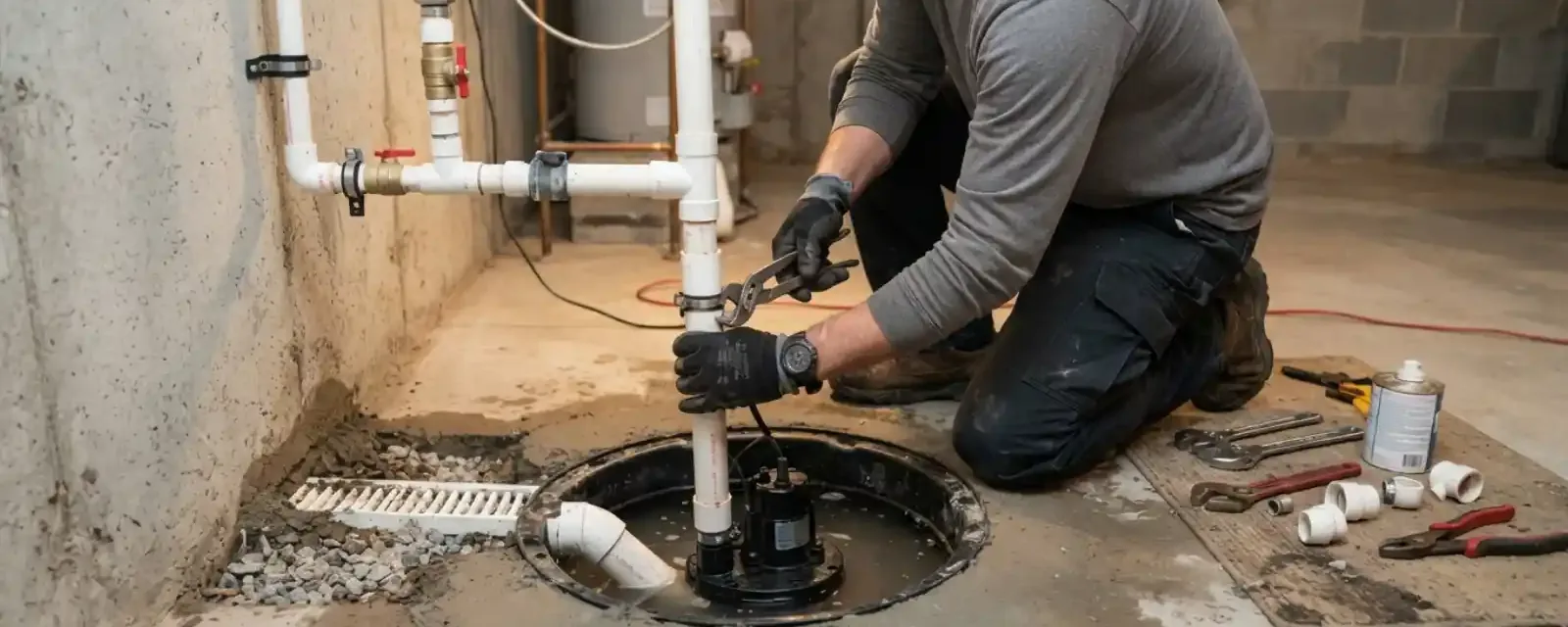
A sump pump discharge line carries water from the pit in your basement to a safe place outside. In Lawrence, MA, that place should not be the sanitary sewer, and the line needs a check valve so water does not flow back into the pit. A line that ends in the wrong place, freezes or clogs can leave you with a flooded basement even if the pump works.
This guide covers where to discharge, what the line needs and what to ask before work begins.
Where the water can and cannot go
Choosing the discharge point is the most important decision in the whole job.
| Discharge point | Status | Why it matters |
|---|---|---|
| Sanitary sewer or house drain | Do not connect | Greater Lawrence Sanitary District guidance says to keep sump pumps out of it |
| Yard, away from the foundation | Common choice | Water must flow away and not return |
| Storm drain or street | Ask first | Local rules and ownership vary |
| Neighbor's property | Avoid | Creates disputes and can flood them |
| Dry well or rain garden | Possible | Needs soil that drains and a plan for heavy storms |
Ask the local plumbing inspector which disposal methods are acceptable at your address.
What Lawrence guidance says about sump water
Greater Lawrence Sanitary District guidance tells homeowners to make sure sump pumps and basement drains are not connected to the sanitary sewer. Lawrence has combined sewer overflows along the Merrimack and Spicket Rivers, and extra water in the system can push sewage out in heavy rain.
No Lawrence sump pump ordinance has been identified, so do not assume that anything is allowed. Ask Lawrence Water & Sewer at 978-620-3110 before you connect a discharge to a storm drain or the street. Andover's sewer regulations bar sump water from the sanitary sewer outright.
Source type: Greater Lawrence Sanitary District guidance
What a proper discharge line installation includes
The parts are simple, but each one has to be right.
Choose the route
The line should leave the pit by the shortest path to a safe discharge point. Fewer elbows means less friction, and a straight rise helps the pump move water.
Install the check valve
Massachusetts plumbing code calls for an accessible check valve on sump and ejector discharge piping. It keeps water in the line from falling back into the pit each time the pump stops.
Pipe and seal
Use rigid pipe sized for the pump, joined with proper cement or couplings. A small relief hole in the line can help the pump if it airlocks, and a plumber can advise on this.
Terminate outside
The line ends several feet from the foundation, pointing away from the house and toward ground that slopes down. A cap or screen keeps animals and debris out.
Pit full and the discharge is a mystery?
A licensed plumber can trace the line, test the pump and fix the discharge before the next storm.
Winter is the line's biggest risk
A discharge pipe that sits above ground can freeze solid in January, and the pump will run with nowhere to push the water. State code puts frost depth at 48 inches, which is a reason to bury a run properly or slope it so it drains between cycles. The NOAA January average low for Lawrence is 19.6 F, so freezing nights are normal.
A frozen line can also back water into the pit and overheat the pump. Pitched pipe, a freeze-resistant outlet and a clear path to a downhill spot help. Ask your plumber about options that fit your yard.
DIY check or a licensed plumber
You can look at the system without touching anything. The work itself is another matter.
Safe for you to do
- Pour a bucket of water in the pit and watch the pump start
- Walk the outside line and check that it is clear and pointing away
- Clear leaves from the outlet and screen
- Test the backup battery or alarm if you have one
Needs a licensed plumber
- Adding, moving or replacing the discharge line
- Installing or replacing the check valve
- Connecting to a drain, storm system or dry well
- Any pit or pump install, since you should ask the inspector about a permit
Our sump pump service covers repair and replacement of the pump and line. Wet basements that return after the pump runs may also need basement waterproofing to address water entry at the source.
Before you say yes to a quote
A good scope answers these questions in writing.
- Where does the line end, and is that point allowed at your address?
- Is there a check valve, and can you reach it later?
- How will the line avoid freezing, and how deep will any buried section be?
- Does the quote name who pulls the permit, or says to ask the inspector?
- Is a backup power or battery option included?
- Does the plumber confirm the line will not tie into the sanitary sewer?
Insurance and standing water
The Massachusetts Division of Insurance says sump pump failure and sewer backup are excluded from standard policies unless you add an endorsement. Check your policy before storm season, not after a flood.
Floods have happened in Lawrence before. The city plan notes the Arlington neighborhood flooded in 2001 and 2006, and over 17 percent of the city sits in the 100- and 500-year floodplains. If your home is in a low area, a reliable discharge matters more.
Nearby towns, different rules
We also serve Andover and Methuen. Rules and inspector contacts change from town to town, so confirm with the local plumbing inspector. In Andover, call the inspections line at (978) 623-8603. In Methuen, call the plumbing inspector at 978-983-8634.
Sump pump discharge questions
No. Greater Lawrence Sanitary District guidance says sump pumps should not be connected to the sanitary sewer. Extra water can overload the system in heavy rain.
Yes. Massachusetts plumbing code calls for an accessible check valve on sump and ejector discharge piping. It stops water from flowing back into the pit.
Far enough that water slopes away and does not return, often several feet or more. Your plumber can set the distance for your lot and grade.
Ask the local plumbing inspector. Lawrence Inspectional Services is at 978-620-3130. Plumbing work that installs or replaces piping generally needs a permit, and only minor leak repairs and clearing a clog do not.
The pump can run with no outlet, overheat and fail while the pit fills. Check the outlet in cold weather and call a plumber if water is not leaving the pipe.