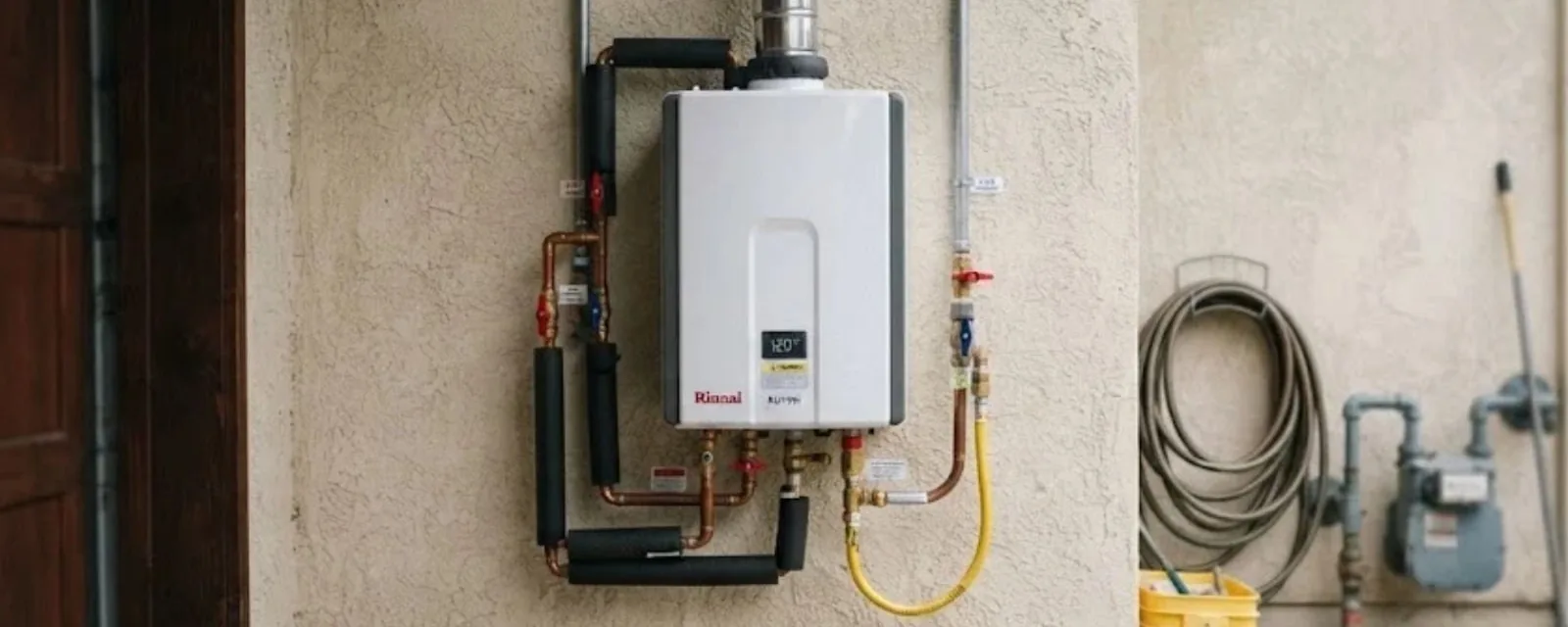
A tankless water heater in Lawrence, MA heats water only while a tap is open. When you turn on a faucet, a flow sensor detects the water, a burner or electric element switches on, and a heat exchanger warms the water as it passes through. There is no 40 or 50 gallon tank sitting hot all day.
That means a steady supply that does not run out in the middle of a shower, as long as the unit is sized for the demand. It also means different installation needs and a winter performance limit that matters in New England.
What happens in the 30 seconds after you open the tap
Every tankless unit follows the same four-part sequence, gas or electric.
Flow sensor trips
Water moving through the unit past a minimum flow rate tells the control board that someone wants hot water. Very low flow can fail to trip it.
Heat source fires
A gas unit lights a burner. An electric unit powers heating elements. Either one is controlled to match the water flow and temperature you want.
Heat exchanger transfers heat
Cold water passes through coils or plates heated by the burner or elements. The water gains heat in seconds as it moves through.
Thermostat adjusts output
Sensors watch the outlet temperature and tweak the firing rate. When you close the tap, the flow stops and the heater shuts off.
Parts worth knowing by name
When a technician says a part failed, this is what each one does.
Flow sensor
Detects water movement and starts the heating cycle.
Heat exchanger
Transfers heat from the burner or elements to the water. Scale can clog it.
Control board
Reads sensors, adjusts the heat, and displays error codes.
Venting and condensate line
Carries exhaust outdoors on gas units. High-efficiency models also drain acidic condensate, which needs a proper path.
Inlet filter
A small screen that catches debris before it reaches the exchanger.
Isolation valves
Let a plumber flush the unit with descaler without cutting water to the house.
Why Lawrence winters change the math
NOAA's 1991-2020 normals for the Lawrence station show a January average low of 19.6 F. In cold months, incoming water is often colder than in summer. A tankless heater has to lift that colder water to your set temperature, so the same unit can deliver less hot water per minute in January than in July.
So size the unit for winter, not summer. Tell your plumber your number of bathrooms, your showers that run at once, and whether you want a laundry or dishwasher on at the same time. A single unit that is sized for summer can leave a second shower lukewarm in February.
Source type: NOAA climate normals
Not sure what size you need?
Describe your household and your fixtures. We will walk through what a tankless setup would need.
Tankless versus a storage tank
Neither is always better. The right choice depends on how you live.
Tankless strengths
- Does not run out while the unit can keep up
- No standby heat loss from a stored tank
- Smaller wall-mounted footprint
- Often a longer service life with maintenance
Tankless trade-offs
- Higher install cost than a like-for-like tank swap
- Winter flow rate can drop
- Gas units may need bigger gas piping and special venting
- Needs regular descaling in many homes
If your hot water use is low and your basement is tight, a tank may fit better. If you have a big household or an unused tank corner, tankless can make sense.
Gas, electric, and what installation requires
A gas tankless unit burns more gas per minute than a tank burner. Gas piping is sized under NFPA 54 as adopted in Massachusetts, so the existing line may need upgrading. Vent type and routing also change with the model.
Electric tankless units draw a large load and may need a dedicated circuit and a panel upgrade. A licensed electrician handles the electrical side while the plumber handles water and gas connections.
In Massachusetts, plumbing and gas fitting work needs a permit from the local inspector and a licensed professional. Replacing a vented gas appliance also requires a carbon monoxide detector on the same floor and each habitable level. Our tankless water heater page explains the options, and the water heater replacement page compares swapping like for like. Venting and gas sizing for a tankless unit follow the manufacturer's installation standards and the gas piping standards adopted in Massachusetts.
Troubleshooting signs and likely causes
These are common patterns, not a diagnosis.
| Sign | Common cause | Next step |
|---|---|---|
| Hot water turns cold at low flow | Flow too low to keep firing | Open the tap further, call if it repeats |
| Fluctuating temperature | Scale or a failing sensor | Descale or service |
| Error code on display | Venting, ignition, or flow issue | Check the manual, then call |
| No hot water at all | Gas, power, or sensor fault | If gas smell, leave and call 911 |
| Water flows slowly | Clogged inlet filter | Ask a plumber to clean it |
If you smell gas, leave the building, call 911 from outside, and then call Eversource Gas.
Questions to settle before you buy
Run through these with your plumber before you commit.
- How many fixtures run at the same time in a busy morning?
- Is my gas line big enough, or does it need upgrading?
- Where will the vent exit the house?
- Where will condensate drain?
- Does my water leave scale, and should I add a softener or filter?
- What is the maintenance plan, including yearly flushing?
- Is a recirculation loop or buffer tank advisable?
Tankless questions from Lawrence homeowners
It supplies hot water continuously as long as demand stays within its flow rating. Run too many fixtures at once, especially in winter, and the temperature can drop.
Sometimes. A multi-unit building may need one larger unit or one per apartment, plus venting and gas sizing for each. A plumber can map the layout before you choose.
Most do. Mineral scale can build on the heat exchanger, so many manufacturers call for periodic flushing. Since Lawrence's report does not list hardness, testing your tap helps set the schedule.
Yes. Plumbing and gas fitting work needs a permit from the local inspector, and a licensed plumber should pull it. Inspectional Services is at 200 Common St, Room 209.
Many can. Some models include recirculation, and others need a buffer tank or a compatible setup. Ask your plumber to confirm before adding one.