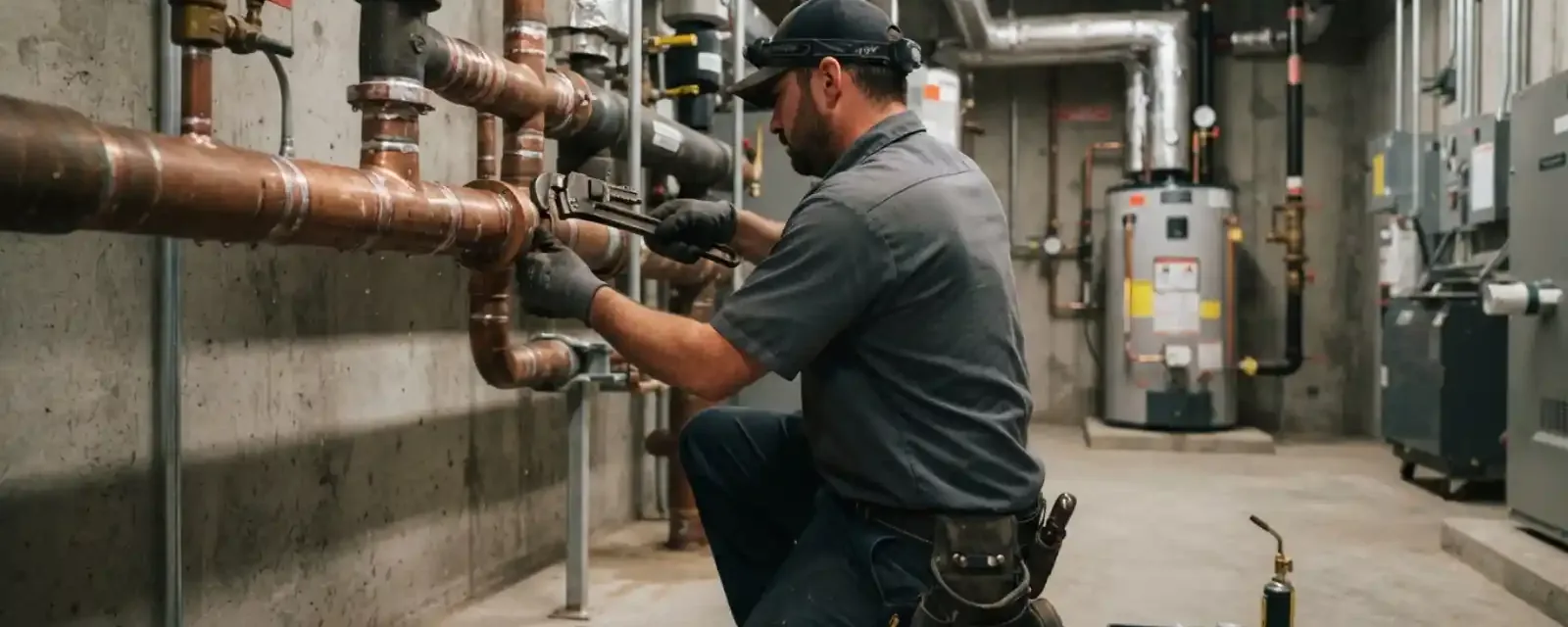
Commercial plumbing in Lawrence, MA is the same trade as home work with higher stakes: more fixtures, larger pipe, regulated devices and tenants who cannot wait. When a floor drain overflows, a main leaks above occupied space or a restaurant loses its sinks, call our 24/7 dispatch line.
While you wait, close the main or the zone valve, move stock and electronics off the floor, tell tenants, and photograph the water for your insurer.
While you wait: protect the building
Commercial water spreads fast through shared floors and ceilings.
Find the main
Locate the building's main shutoff or the zone valve for the wing. Staff should know where it is before the emergency.
Protect stock and power
Lift boxes and equipment off the floor. Turn off power at the panel only when you can reach it dry.
Warn the floor below
Tell downstairs tenants right away. Water that reaches a ceiling can bring tile and insulation down.
Document everything
Take photos and video of damage, shutoff location and the time you noticed. Insurers often ask.
A drain overflow or leak that cannot wait
Some commercial faults are emergencies. A floor drain that backs up gray or sewage water, a ruptured line over inventory, a lost domestic supply in a restaurant and a broken toilet riser in an office all justify a night or weekend call.
Others can be scheduled. A dripping faucet, a slow lavatory or a running urinal is worth a planned visit. If you are unsure, call and describe the water, where it is and how far it is spreading. Commercial work here follows the Massachusetts plumbing code, 248 CMR 10.00, and backflow device testing follows the MassDEP standards in 310 CMR 22.22.
Floor drain overflow
A floor drain that rises is often a blockage in the branch or building drain. In heavy rain, combined sewers can overload, so a backup in several drains at once may be a lateral or city main issue. The property owner owns the lateral, and the city sewer overflow report line is 978-620-3580 or 978-620-3110.
Urgent or scheduled
A quick way to sort the call.
| Situation | Treat as | Why |
|---|---|---|
| Water spreading across occupied floors | Emergency | Damage grows by the minute. |
| Sewage or gray water from a floor drain | Emergency | Health risk and business interruption. |
| No water to a restaurant or clinic | Emergency | Many businesses cannot operate. |
| Slow drain, one fixture | Same-day if available | Often a clog that can wait a few hours. |
| Annual backflow test | Scheduled | Planned compliance work. |
When in doubt, call. A plumber on the phone can help you decide.
Commercial leak detection
A leak in a commercial building can sit behind a ceiling, under a slab or in a riser shared with other tenants. Finding it means shutting off zones, watching the meter, listening on pipe, using thermal cameras on walls and, where it fits, pressure testing.
Be honest about limits: not every leak can be pinpointed without opening something, and a leak in a pipe owned by another tenant or the landlord is outside your scope. We say so up front, give you what we found and, if needed, point you to the building owner.
For the full method, see leak detection. If the meter keeps moving with everything off, start there.
Water on the floor of your business?
Call the 24/7 line. Describe the water and the building, and a licensed plumber will tell you what to shut off.
Backflow testing: planned compliance work
Backflow preventers keep dirty water from flowing back into the public supply. Under Massachusetts rules (310 CMR 22.22), tests must be done by a tester certified by MassDEP. Double check valve assemblies are tested annually, and reduced-pressure devices are inspected semiannually.
The owner pays for testing and repairs. A failed device must be repaired or replaced and retested within 14 calendar days, and a licensed Massachusetts plumber installs and repairs the device. Test reports go to the water supplier and the owner within 30 days.
Lawrence Water & Sewer rules also require a reduced-pressure or double check device on irrigation systems. Call 978-620-3110 to confirm how the city tracks permits and test reports, and mark your testing dates on a calendar rather than waiting for a notice.
Grease traps, storm drains and other commercial systems
These are typical commercial problems, each with limits.
Grease traps and interceptors
Kitchens need them to catch fats before the drain. Lawrence has a fats, oils and grease permit program, so ask the city what your kitchen needs. Pumping is often done by a hauler, while our work is the plumbing around it.
Storm drains and roof leaders
Roof and yard drains can clog with leaves and silt. Lawrence has combined sewers in parts, so ask Lawrence Water & Sewer before changing where drains go.
Restroom fixtures
Flush valves, urinals, floor-mounted toilets and sinks often fail at the worst hour. We repair or replace them.
Water heaters
Commercial-size units and recirculation lines. See water heater repair for the repair process.
Main drain cleaning
Roots, grease and debris in building drains. Jetting or cabling is chosen based on the line.
Gas fitting
Gas piping is licensed gas fitting work under a gas permit. If you smell gas, leave, call 911, then the gas company.
Mill buildings and multifamily properties
Lawrence has about 12 million square feet of mill space, per its Housing Production Plan, and many buildings have been converted to apartments, offices and shops. Ask your plumber to find the main, risers and drains that were added during conversion, because old and new systems can be mixed in one building.
About 28 percent of Lawrence housing sits in 3-4 unit buildings, and about 72 percent is renter-occupied. For landlords, state code requires hot water between 110 and 130 F and treats losing water for 24 hours or more as endangering health and safety, so a failed riser is both a repair and a compliance problem.
How we work on a commercial call
The sequence keeps the building running.
Call and triage
Tell the dispatcher what, where and how much. They help you shut off the right zone.
On-site assessment
The plumber confirms the source with meter checks, camera or pressure test, as fits.
Price before work
You get a clear price before the repair begins, and any permit goes through the local inspector.
Repair and report
The work is tested and you get notes on cause and next steps, useful for the owner or insurer.
What affects commercial plumbing costs
Commercial jobs vary more than residential ones.
Questions from owners and property managers
Yes. The dispatch line runs 24/7 for commercial leaks, overflows and lost water, subject to availability. We do not promise an arrival time, but we will help you shut off water by phone.
Yes, if you have written authority from the owner. Ask the owner what spending limit applies, and we will provide a clear price and a written note for their records.
Double check valve assemblies are tested annually and reduced-pressure devices are inspected semiannually in Massachusetts. Tests must be done by a MassDEP-certified tester.
The property owner owns the lateral from the building to the city main. Confirm the details with Lawrence Water & Sewer at 978-620-3110.
Yes. We find the blockage with cable, jetting or camera, and tell you whether it is the branch, the building drain or the lateral. See drain cleaning.
Grease interceptor pumping is often done by a hauler. We inspect, repair and clear the plumbing connected to the trap, and can help sort out what the city's FOG program expects.