Water is spreading somewhere you cannot see, and it will not wait for business hours. Our licensed plumbers answer the 24/7 dispatch line, and while you wait you can shut off the main valve and move belongings off wet floors.
Leak detection in Lawrence, MA means locating a hidden leak with instruments instead of guesswork. The goal is one small, accurate opening at the real source, not a wall full of exploratory holes.
Is your meter still moving or your water bill climbing for no reason?
A meter that keeps turning with every fixture off, or a bill that jumps with no change in the household, usually points to water escaping somewhere out of sight. The technical name for the fix is leak detection, and it starts with proving the leak is real before anyone opens a wall.
You can run the first test yourself in ten minutes. Turn off every tap, the dishwasher, the washing machine and the ice maker. Find the meter, usually near where the line enters the basement, and look for the small low-flow dial or triangle that spins with even a trickle.
Read it twice
If the dial moves, note the reading, wait an hour with nothing running, and read it again. A change means water is leaving the system. A running toilet is the usual false alarm, so drop food coloring in the tank and see whether it reaches the bowl without a flush.
When the dial still spins
Close the main shutoff inside the house. If the dial stops, the leak is inside your walls or floors. If it keeps moving, the loss is on the pipe between the meter and the street, or at the meter connection. That split tells us where to start.
When a hidden leak becomes an emergency
Some leaks can wait for a morning appointment. Others cannot. Call the 24/7 line right away if water is coming through a ceiling, pooling near the electrical panel, or soaking a finished basement, or if the main shutoff will not close. A pipe that has split outright is a burst pipe job.
A slow drip you have only noticed on the bill is different. Shut the main off at night if you can, and book the earliest visit. Same-day appointments are available when the schedule allows, and after-hours dispatch covers the urgent calls.
While you wait for the leak detection visit
A few minutes of work now limits the damage and helps the plumber find the source faster.
Shut off the main
Close the main valve and open one low faucet to drain the lines. If the meter stops moving, you have confirmed the leak is downstream of the house valve.
Protect the electrics
If water reaches an outlet, light fixture or panel, stay out of the wet area. Switch off the breaker only if you can reach it while standing on dry floor.
Catch and move
Put a bucket under a drip, lift rugs and stored boxes off wet floors, and set a fan on damp drywall. Do not poke or cut into a bulging ceiling.
Note what you see
Write down where stains appeared, whether they grow, and the meter reading with the time. A short timeline saves real diagnostic effort.
If you smell gas along with any water problem, leave the building and call 911 from outside before you call anyone else.
Signs the leak is behind the surface
Hidden leaks leave clues long before water pools on a floor.
- A water bill noticeably higher than the same season last year with no change in household.
- A meter dial that moves when every fixture and appliance is off.
- Brown or yellow stains, peeling paint or bubbling plaster on a ceiling or wall, often below a bathroom or kitchen.
- A musty smell in a closet, basement or crawlspace that does not fade with ventilation.
- Warm patches on a floor, which can point to a leaking hot water line.
Why older Lawrence buildings hide leaks well
The city's own housing plan reports that about 53 percent of Lawrence housing units were built in 1939 or earlier, and about 28 percent sit in three- and four-unit buildings. Older multi-family buildings often have pipes running through shared chases, behind plaster and under several layers of flooring, so a drip in one unit can show up in another. So we trace with instruments and ask which units share a stack before opening anything.
The city's housing documents do not list pipe materials by era, so we do not guess. Ask the plumber what your supply and drain lines are made of, because galvanized steel, brass and copper fail in different ways.
How we find a leak without guessing
No single tool finds every leak. The method depends on where the water is and what the pipe is made of.
Meter and isolation testing
We close valves in sequence and watch the meter, which narrows the leak to a branch, a floor or the outside line.
Acoustic listening
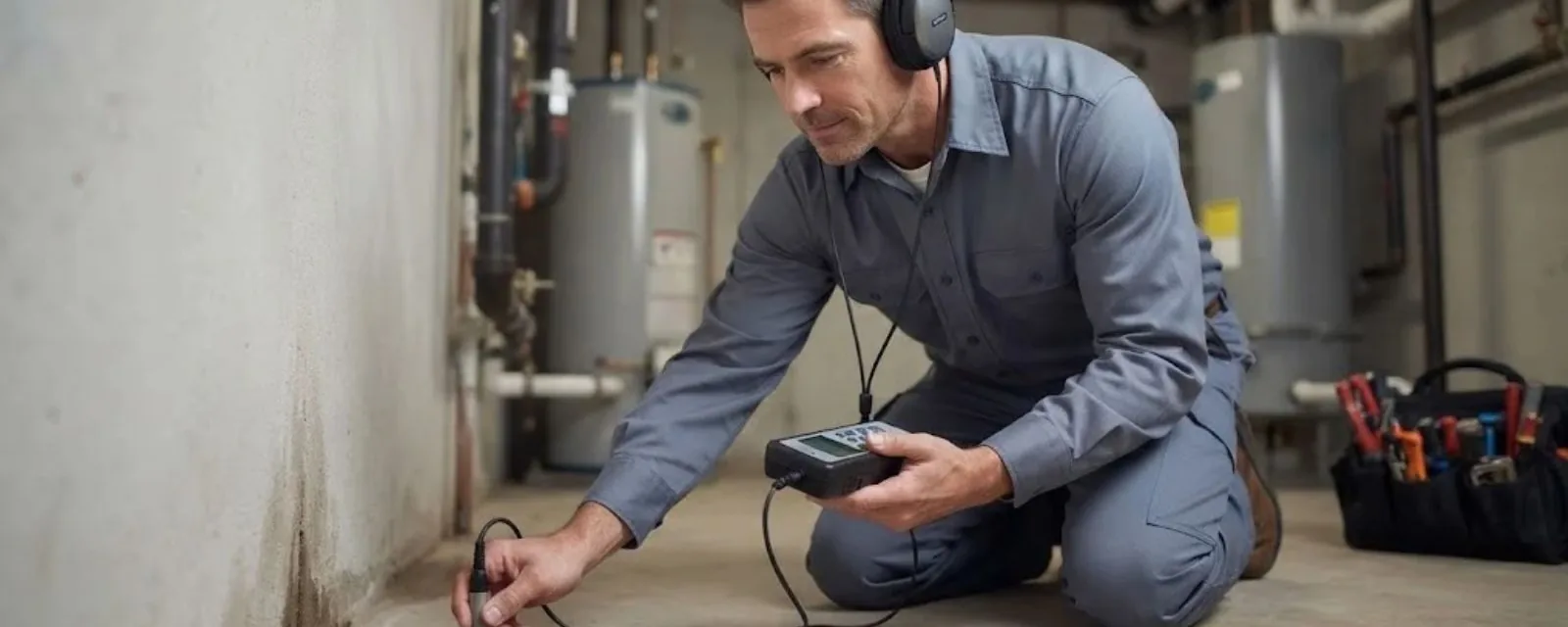
Ground microphones and contact sensors pick up the hiss of pressurized water escaping, often through concrete, soil or a wall.
Thermal imaging
An infrared camera shows temperature differences from wet material or hot water lines. It reveals patterns, and moisture meters confirm them.
Pressure testing
We cap a section of pipe and watch the gauge. A falling needle proves a leak in that run even when nothing is visible.
Tracer gas
A harmless gas mix is pushed into an emptied line and a sniffer finds where it escapes. It is useful for hard-to-hear leaks in buried or slab pipe.
Water stains on a ceiling or wall
A stain on the ceiling is where the water ended up, not necessarily where it started. Water follows joists, pipes and framing before it shows, so the source may sit several feet away. In a triple decker, the origin is often in the unit above.
If the stain grows only when someone showers, the drain or tub trap is the likely suspect. If it grows around the clock, a pressurized supply line is more likely.
Once found, the repair usually needs one opening about the size of the fitting. We say what we plan to cut before work begins.
Under the house, in the crawlspace or basement ceiling
Many New England buildings have a basement or low crawlspace, which makes pipes easier to reach but lets leaks go unnoticed for months. Look for rust stains on fittings, white mineral crust, damp insulation and wet joists.
A basement ceiling that is exposed gives us a direct line to supply and drain runs. In a finished basement, we use thermal imaging and moisture readings before cutting access.
Think there is water where it should not be?
Describe what you see and the dispatcher will tell you whether it is an urgent call or can wait for a scheduled visit.
A leak somewhere in the buried line
The service line carries water from the street main to your meter and house. A leak there can be invisible: no wet floor, just a climbing bill, a soft lawn patch or low pressure. We find it with a meter test, ground microphones, and sometimes tracer gas.
Ownership matters before anyone digs. Lawrence Water Division rules say the city repairs from the main to the curb stop, and the owner is responsible from the curb stop onward, while the city web page describes responsibility as running up to and including the meter. Because those two statements differ, confirm with Lawrence Water & Sewer at 978-620-3110 before authorizing an excavation. For the repair side, see our water line repair page.
Irrigation, pools and the meter box
Lawn sprinkler systems often leak at valve manifolds, broken heads and buried joints, and a wet zone or oddly green patch is the usual sign. Lawrence rules require a reduced pressure or double check backflow device on irrigation systems, so ask us to check it during the test.
Pools, spas and the meter box
We can pressure test plumbing lines that feed a pool or spa, though shell leaks often need a pool specialist and we will say so. Water pooling in the meter pit may come from a fitting on the street side, which may be the city's to repair, so photograph it and call Lawrence Water & Sewer before digging.
After the leak is found: repair options
Finding the leak is half the job. The next decision is how much pipe to fix.
| Situation | Common fix | Trade-off |
|---|---|---|
| Single pinhole in good pipe | Cut out and splice a short section | Fast and low cost, but nearby pipe may fail next |
| Several leaks along one run | Replace the whole run | More work now, fewer repeat visits |
| Leak inside a wall | Open a small access panel | Needs patching, but avoids cutting plaster everywhere |
| Leak under concrete or a floor | Reroute the line overhead or around | Avoids breaking the slab, uses more pipe |
Plumbing repairs in a home need a permit from the local inspector. Only minor leak repairs are permit-free, and your plumber can tell you which category applies.
What affects the cost of leak detection
Leak detection questions from Lawrence homeowners
Yes. The dispatch line is open 24/7 for active leaks, ceiling water and failed main shutoffs. We do not promise an arrival time on the phone, but we tell you what to do while you wait and book the earliest slot available.
Turn off everything that uses water, then watch the low-flow dial on the meter. If it keeps moving, or the reading changes after an hour, water is leaving the system. Closing the main valve and checking again helps tell an inside leak from an outside one.
It is possible, though many Lawrence buildings have a basement or crawlspace. Garages, additions and some newer sections can sit on a slab. Warm floor patches or running-water sounds under concrete point that way, and we confirm with listening gear and pressure tests.
Sudden, accidental damage in a heated and occupied home is typically covered, according to state insurance guidance. Gradual leaks are not addressed, so ask your agent. A written finding from the plumber helps your claim.
City rules put the street-to-curb-stop section on Lawrence Water & Sewer and the rest on the owner, but the city web page says through the meter. Call 978-620-3110 to confirm your property before any digging.