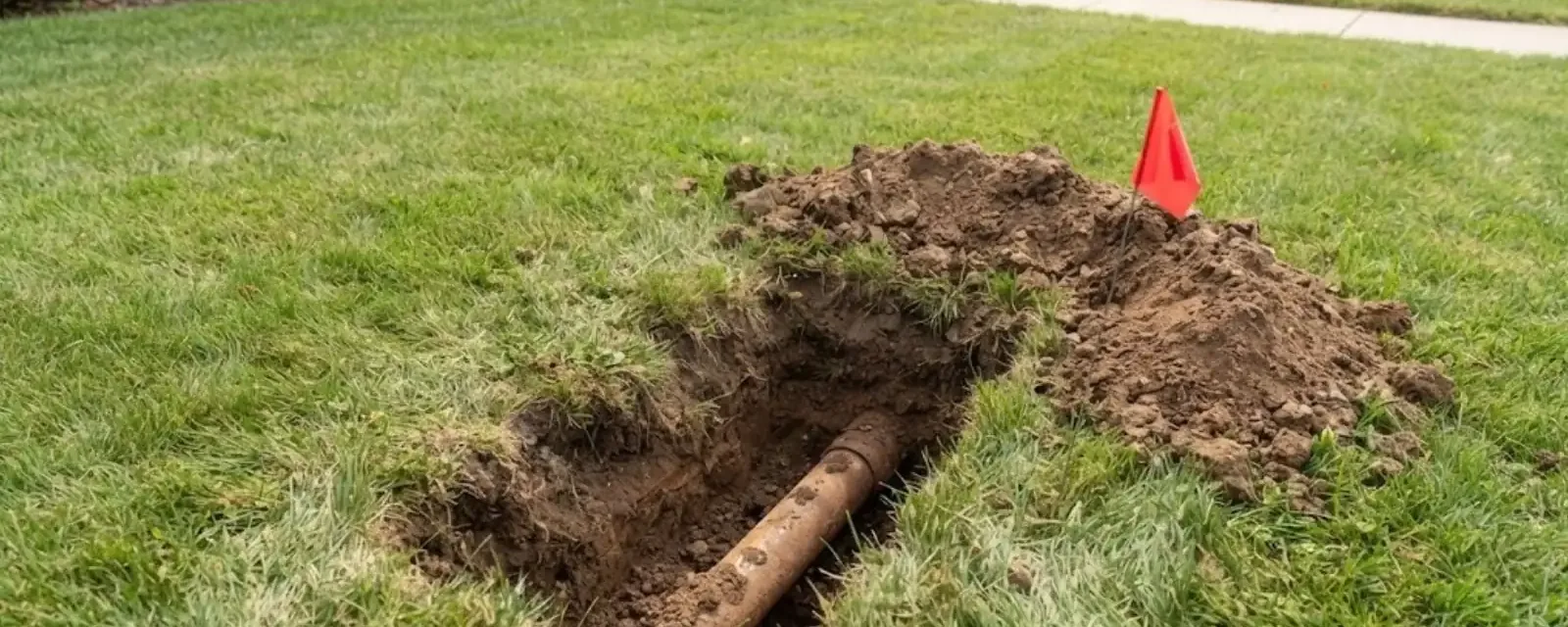
Lateral sewer line repair in Lawrence, MA means fixing the pipe that runs from your house to the city sewer main under the street. In Lawrence the property owner owns that pipe, so a break, a root-filled joint or a collapsed section is your bill to handle, not the city's.
The usual warning is a drain that keeps backing up after it has been cleared. Below you will find the signs, the repair choices side by side, and the Lawrence details that change what you should ask a plumber before you agree to anything.
Why a lateral fails and a clog is not the whole story
A lateral is a gravity pipe, so it needs a steady downhill slope to carry waste. Over time the ground shifts, joints open, and the pipe can sag into a belly where water and solids settle. Tree roots look for moisture and can slip into an open joint, then thicken until they catch paper and grease.
Older pipe is a common weak point. Clay and cast iron can crack with age. Pipe material by building era is not documented for Lawrence, so the only way to know what you have is to look at it with a camera.
Warning signs the lateral, not the house drain, is the problem
A single slow sink is usually local. These patterns point down the line.
Several fixtures back up together
When the basement floor drain gurgles while a toilet flushes upstairs, the blockage is often past the branch lines.
The clog keeps returning
A drain cleared on Monday and slow again by the weekend often means a cause that snaking cannot remove, such as roots or a belly.
Sewer smell in the basement or yard
A steady odor outside near the foundation can mean a crack leaking sewage into the soil.
Soggy or sinking ground
A wet strip of lawn that does not dry, or a dip in the yard along the pipe path, can mean a collapse.
Gurgling after laundry or showers
Air trapped by a partial blockage escapes through traps and makes noise.
Rodents or insects near drains
A broken pipe can give pests a path in from the soil.
If sewage is coming up into the house right now, keep people and pets away from the water and call the dispatch line. Do not use the plumbing until it is cleared.
Spot repair or full replacement, the honest trade-offs
The right choice depends on how much of the pipe is damaged, which a camera inspection should tell you before any dig.
Spot or section repair
- Fits one cracked joint or a short collapsed run.
- Smaller excavation and shorter disruption.
- Leaves the rest of an old pipe in place, so another failure may show up nearby.
- Makes the most sense when the camera shows sound pipe on both sides.
Full lateral replacement
- Fits pipe that is cracked, bellied or root-filled along much of its length.
- Replaces the weak link end to end, which can reduce repeat backups.
- Bigger job with more digging or a trenchless method where the line allows it.
- Often the more sensible spend when repeated spot repairs would add up.
Trenchless methods such as pipe lining or pipe bursting can avoid opening a long trench, but they need a pipe with the right shape and access points. Ask your plumber why a method fits your line, not just which one is offered.
Sewer backing up now?
Our 24/7 dispatch line is open. Tell us which fixtures are affected so a licensed plumber can plan the right tools before arriving.
What Lawrence property owners should know about the sewer system
The city maintains 137 miles of sanitary and combined sewer mains, and flow goes to the Greater Lawrence Sanitary District plant in North Andover. The lateral, the house-to-main pipe, is the owner's responsibility. So before you hire a digger, ask your plumber to confirm on camera whether the problem is in your lateral or in the city main, since the answer decides who pays.
Lawrence also has combined sewers and several overflow points along the Merrimack and Spicket Rivers, and a 2015 federal consent decree requires the city to inspect and repair its system. For you, the point is practical. Heavy rain can load the main, so a backup during a storm may not be your pipe's fault. Report overflows to 978-620-3580 or 978-620-3110, and keep sump pumps and basement drains off the sanitary sewer, as the district advises.
Source type: Greater Lawrence Sanitary District guidance
How a lateral repair job usually runs
Every site differs, but the sequence is usually the same.
Camera inspection
A camera on a flexible line goes in through a cleanout to show cracks, offsets, roots and the location of the damage.
Locate and mark
A locator tracks the camera head from above so the dig, if any, is placed on the right spot and the right depth.
Permit and notice
Plumbing work that is repaired or replaced needs a permit from the local inspector. In Lawrence, ask Inspectional Services. Digging may also need utility marking before work begins.
Repair, test and restore
The damaged section is replaced or lined, flow is tested, and the inspector signs off before the trench is closed and the surface is restored.
What decides the price of a lateral job
Anyone quoting a figure before seeing the pipe is guessing. These are the real variables.
Lateral sewer questions we hear in Lawrence
No. The city maintains the sewer mains. The lateral running from your house to that main belongs to the property owner. A camera inspection shows which section is failing, which is how you find out where the city's duty ends and yours begins.
Sometimes. A spot repair needs only a small excavation, and trenchless lining or bursting can avoid a long trench when the pipe shape and access allow it. A camera inspection tells you whether your line qualifies.
It varies by building, so the answer should come from a camera run, not a guess. Lawrence has many two-family and three-family buildings, and a shared lateral changes who pays and how the repair is planned. Ask your plumber to trace it.
Repeated backups after cleaning usually point to a structural fault such as roots in a joint or a sagging section. Ask for a camera inspection before paying for another cleaning.
Plumbing work that is repaired or replaced needs a permit from the local inspector. Contact Inspectional Services at 978-620-3130, or ask your licensed plumber to pull it.